Google Ads for Family Law Firms
Family law advertising on Google, with real numbers: the math to run first, the structure that fits how people search, and the mistakes that drain budgets.
By Josh Kilen · Updated July 16, 2026
You’ve probably been through this before. Two or three marketing companies, each with a confident founder on the first call and a junior you never met running the account by the second month. The reports arrive full of impressions and clicks, and not one line in them connects any of that motion to a signed case. What you actually want is simple, and almost nobody offers it plainly: show me a client who walked through the door because of the money I spent.
We’ve run Google Ads for family law firms since 2016. Across those years I’ve watched one channel produce wildly different outcomes from one account to the next, and the gap between them is rarely where people go looking for it.
Two accounts make the point. One is a family law firm whose account we built from scratch, and it booked 2,746 appointments from launch, climbing month over month. The other bought clicks for years with its conversions sitting flat at zero, until a handful of corrections turned that same account into 3,886 booked appointments and counting.
What separated those two accounts was a short list of ordinary mistakes, found and fixed. No proprietary tactic, no secret audience, no channel that only agencies can reach. Family law advertising on Google tends to fail in a small number of predictable ways, and every one of them is findable in your own account this afternoon.
This guide is that list. It covers the math to run before you spend, the account structure that fits how people search, the quiet drains that bleed a budget, where Local Services Ads fit, and how to tell whether any of it is producing cases. Read it and never call us, and you should still be able to fix your own account by the end.
Why Google Ads is the fastest lever in family law marketing
Google Ads is the fastest way to put a family law firm in front of someone who is searching for help right now, which is why it starts working before any other channel can. A person typing “how to file for divorce” or “child custody lawyer near me” has already admitted to themselves that they have a problem. Paid search reaches them in that exact moment. Organic search compounds slowly and is worth building for that reason, but it cannot capture today’s searcher today. That is the division of labor: paid catches intent now, organic earns trust over the following year.
The demand under that search box is larger than most owners assume. There were 672,502 divorces in the United States in 2023, roughly 40% of marriages still end in divorce, and about 56,970 family law attorneys compete for the work that follows. A striking amount of that demand never reaches a lawyer at all. In family law cases, 72% have at least one self-represented party, and 61.9% of uncontested divorces had no representation on either side. Those are people quietly typing questions into Google, weeks or months before they decide to hire anyone.
Firms feel that gap from the inside. “If I could find the clients, I could do 10 times more work,” a solo family lawyer named Alana told Clio’s researchers, “but I don’t have the volume of clients, so I just have less to do.” The channel exists to close that specific distance between capacity and volume. The uncomfortable part is that most of those searchers will hire someone. The only open question is whether the name they find above the fold is yours or the firm that outbid you. That is why I treat family law lead generation as a standing system rather than a good month you hope repeats.
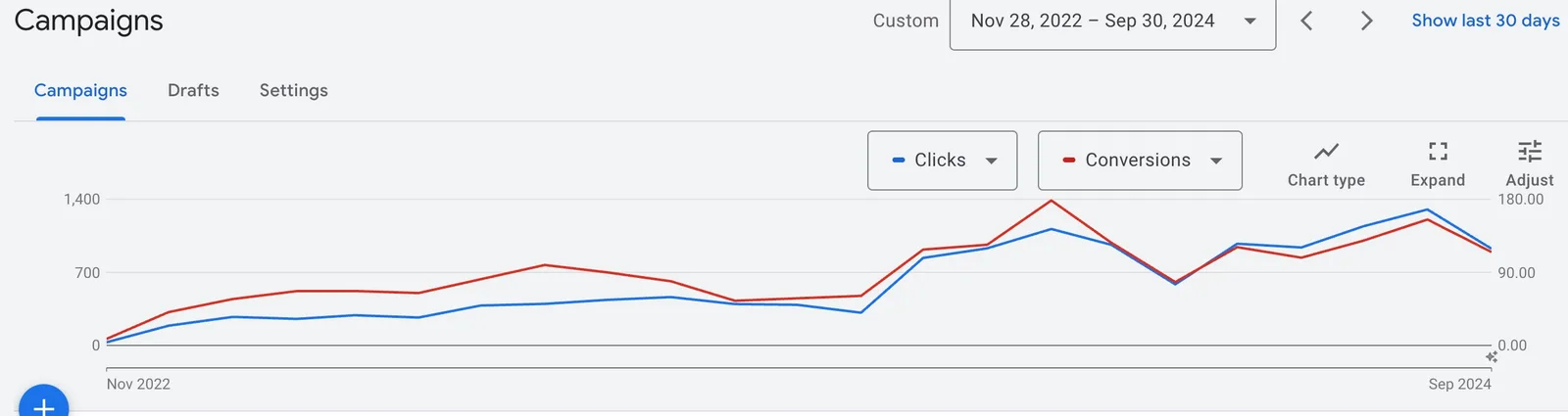 Exhibit A: one family law firm’s account from launch, November 2022 to September 2024. 2,746 booked appointments (appointments, not raw leads).
Now the part nobody else will show you. Across our audit of 351 family law firms in 20 metros, we counted more than $2.4 million a month in aggregate Google Ads spend, and independent local firms alone account for roughly $900,000 to $1 million of it. The largest single advertisers are enormous. Hope Law Firm in Des Moines runs about $295,000 a month, the national chain Cordell & Cordell about $255,000, Bogin Munns about $245,000, and a chain like Cordell shows up spending at that scale in Des Moines, Madison, Boise, and Portland at once. You can read the full benchmark for the market-by-market picture.
A hundred miles can invert the whole auction. In Tucson, the combined paid-search spend of every local family law firm is $1,081 a month, while a single Phoenix chain spends $51,390 a month reaching into Tucson from out of town, about 47 times the entire local market. Grand Rapids was the only metro in the study with no detected paid spend at all. Eugene was nearly as quiet at $2,733. Family law firm advertising is a bloodbath in some metros and a ghost town in others, and a modest budget can own a market the chains forgot to fight for.
Which brings up the pattern that should reframe the rest of this page. A firm in Mobile spends $13,280 a month and earns 8 organic clicks for it. The single largest advertiser in the entire dataset, that $295,000-a-month firm, scores only 66 on our site-visibility audit. Spend and results are not correlated. That is precisely why everything that follows is about structure. Budget size, on its own, decides almost nothing. Before you settle on a number, run the math the chains never bother to show you.
The math to run before you spend a dollar
The right budget for family law PPC comes from one number: how many cases you can actually handle in a month. The cost-per-click figure you read in a blog post is the wrong place to begin. Start from the wrong number and every decision downstream inherits the error.
The click costs are worth understanding precisely because the sources disagree. LocaliQ’s legal-search benchmark puts family law at a 4.70% click-through rate, a $7.69 cost per click, an 8.52% conversion rate, and a $103.54 cost per lead. It is the most-cited figure in the industry, and it is aging: the sample is 256 US search campaigns that ran from April 2022 to March 2023. A newer breakdown from the agency DM Law Partners reports 2026 click costs by sub-keyword that run far higher, $25 to $120 for family law overall, $25 to $80 for “divorce attorney,” and $120 to $220 for high-net-worth divorce. That firm manages more than $25 million in legal ad spend, reports at the keyword level instead of a category average, and has a mild incentive to cite bigger numbers, so hold their range and LocaliQ’s as two honest ends of one picture. You may also see a viral claim that divorce clicks cost $350 to $500. It comes from an account selling leads, with no methodology attached, and it is marketing rather than a benchmark.
The method that works runs backward from your capacity. Decide how many new cases you can take in a month. Divide by a realistic conversion rate, usually 5 to 8%, to get the leads you need. Estimate what a click costs in your market, since top-tier metros run about 1.3 to 1.5 times the base rate and smaller markets 0.6 to 0.9 times, and work out your cost per lead from there. Multiply the leads you need by that cost, add 15 to 25% for management, and check the total against what a case is worth.
Case value is where this math turns friendly. The average family-practice lawyer rate is $344 an hour, the average US divorce runs $15,000 to $20,000, and a contested custody fight can pass $100,000. Set a $103 lead, or even a $220 click, beside a $15,000 matter and the arithmetic stops being frightening. It also explains why 71% of clients say they would rather pay a flat fee, and why a page that names its pricing tends to convert the people your ads paid to attract.
Two guardrails on the budget itself. There is a real floor, and there is no prize for clearing it by a mile. Below roughly $3,000 a month in most mid-size metros, a campaign starves before it collects enough data to improve. Overspending fails in the other direction. One family law firm on r/LawFirm described paying $17,000 a month for a single lead source, while a small firm in Portland, Maine kept two or three lawyers full on $2,000 to $2,500 a month and later dialed it to a few hundred. A big budget on a broken structure only loses money faster. Work through how to size a family law marketing budget before you touch a bidding setting.
Run it once with real numbers so it stops being abstract. Say you can take five new divorce cases a month. At the 5 to 8 percent lead-to-case rate above, that means 60 to 100 leads, and at a cost per lead between LocaliQ’s $104 and the $150 practitioners report, the monthly spend lands somewhere between $6,200 and $15,000 before management fees. That is a real check to write, which is exactly why the math has to run before the campaign does. Now set it against what it buys: five signed matters at $15,000 to $20,000 each is $75,000 to $100,000 in new work. The spend clears several times over. The click price is a footnote.
Campaign structure that fits how people search for family lawyers
Nobody searches “family law.” They search “child custody lawyer near me,” “how to file for divorce in [county],” or “father’s rights attorney,” each phrase a different person carrying a different fear. An account that works is built the way the searches arrive: one intent, one ad group or asset group, and one landing page written for that exact worry.
Melvin & Torrone, a Tacoma firm we manage, shows the shape of it. Their family law campaign, built on Google’s Performance Max campaign type, runs as five asset groups mapped one to one against five dedicated landing pages: divorce, child custody, child support, CPS defense, and protection orders. The geography is drawn tight, a 15-mile radius around Tacoma with King County carved out, on a $75-a-day budget. The structure does one job above all: the parent searching about a CPS investigation lands on a page about CPS investigations, instead of a general “family law services” page where they have to hunt for their own situation while the meter runs.
That alignment matters more than clever ad copy, and the people who audit these accounts say so bluntly. “Our CRO specialist almost had a medical event looking at the most recent new account’s landing page,” one agency owner wrote on r/LawFirm about a firm whose targeting was fine and whose page quietly undid all of it. Search campaigns live or die here. Each practice area needs its own page to convert, and without one the cleanest keyword list in the world just buys clicks that bounce.
Then the question everyone reaches eventually: Search or Performance Max? The honest answer is that it depends on how well the thing is built, and I can show you both truths inside a single account. At Melvin & Torrone, a properly configured PMax campaign for Criminal Defense hit an $18.62 cost per acquisition in March 2026 and $17.91 in April, down from $34.62 a year earlier, and PMax now drives about 78% of the account’s paid conversions. The same account’s county Search campaigns ran a $39 to $60 cost per acquisition over that stretch, two to three times more expensive per conversion.
So PMax wins in this account, and the rep-default version of PMax is exactly what burns small firms, which the next section gets into. Both are true because configuration is the deciding variable, far more than the campaign type itself: account-level conversion goals feeding a clean signal (mark only real leads as conversions, so Google optimizes toward clients instead of clicks), asset groups split by practice area, and a real landing page behind each one. Give PMax those three things and it can become the cheapest line in your account. Withhold them and it becomes the most expensive, quietly and at scale.
One structural fact is not optional. In April 2026, mobile drove 96.8% of Melvin & Torrone’s conversions and 95% of the spend, at a 5.75% mobile click-through rate against 3.96% on desktop. Desktop produced 8 conversions on $294. For a family law client, the desktop is often where the early research happens, and the phone is where the decision to call finally gets made. Your searchers are frequently in a parking lot or a hallway outside a courtroom, so build and test every page on a phone first. Draw your geography as deliberately as your keywords, a radius minus the counties you would rather not pay to reach.
Which leaves the failure mode worth picturing before you launch anything. A perfectly targeted campaign, tuned to the precise searches you want, pointing at a landing page that has spent months patiently repelling every anxious parent who clicked through to it. The targeting was never the hard part.
The mistakes that drain budgets quietly
Most family law accounts leak before they fail, and the leaks come from a short, findable list. These are the ordinary ways PPC for family law loses money without anyone noticing, and every one is something you can check yourself.
The loudest quiet drain is broad match with no negative keywords. When Melvin & Torrone’s county Search campaigns ran fully on broad match, the actual search terms they paid for included “best divorce solicitor” (a British phrase, from the wrong country entirely), “family disputes,” “pro bono lawyers near me,” and “i can’t find a lawyer to take my case.” Every one of those was a cheap click and a zero-fit query. After we tightened the match types, the account’s click-through rate rose from 3.73% to 5.63%, and its Search lost impression share (budget) fell from 58.5% to 19.6%. The junk had been starving the good queries of the money to compete for them.
This is usually where a Google rep enters the story. “Never meet with the reps, they always push broad match, PMax, every automated setting and never mention negative keywords,” one attorney wrote on a widely-upvoted r/LawFirm thread about a rep-built family law account. “They are there to help Google, not you.” That is harsh, and mostly accurate about the settings a rep hands you by default. The automation is not evil. The defaults are tuned for Google’s revenue, and they run on your budget until you take the controls.
Those controls are about to change whether you touch them or not. Google’s April 2026 announcement is retiring Dynamic Search Ads, Automatically Created Assets, and campaign-level broad match into a system called AI Max for Search. Automatically Created Assets and campaign-level broad match begin auto-upgrading in September 2026, and Dynamic Search Ads were pushed to February 2027 after advertisers pushed back. Google’s own data claims about 7% more conversions from the full feature suite. The sensible response is to opt in on purpose, rather than let the upgrade choose your targeting for you.
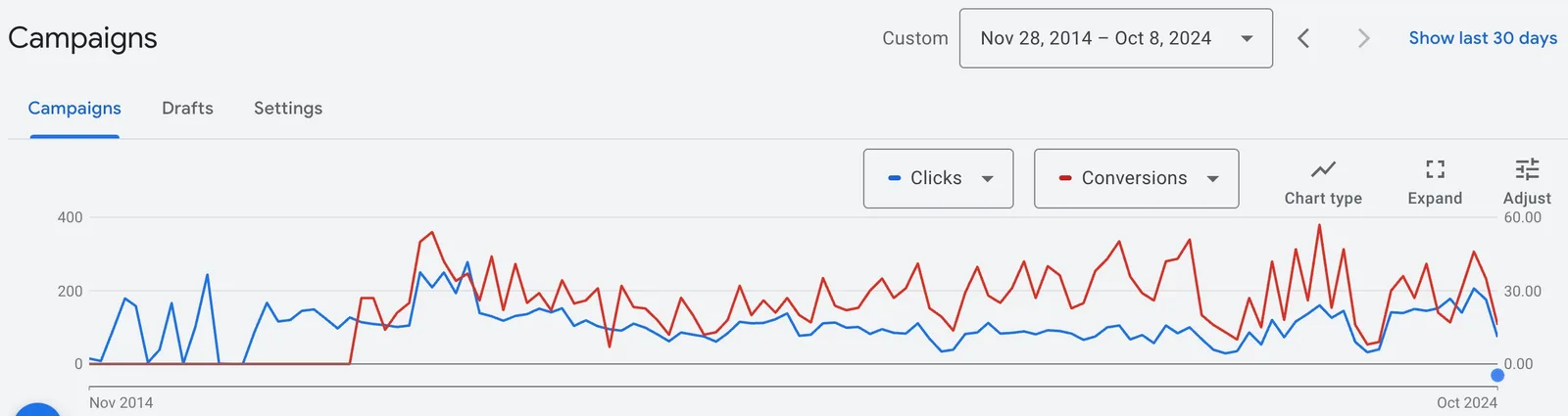 Exhibit B: a firm that bought clicks for years with almost nothing to show for it. A handful of simple corrections later, 3,886 appointments and counting.
The most expensive leak is the one you cannot see. In June 2026, Melvin & Torrone’s Google Analytics 4 (GA4) reported zero conversions for the month. The campaigns were fine. The site had migrated, its thank-you page fired a “generate_lead” event, and nobody had re-marked that event as a Key Event in GA4, so 175 real thank-you-page visits recorded as nothing at all. That was our client and our oversight, and for a few weeks our own dashboard cheerfully insisted a working campaign was dead. If it can happen on an account we run, it can happen on yours.
The rest of the waste hides after the click. PPC Chief estimates that legal accounts commonly lose around a third of their spend to competitor click fraud, over-broad geography, non-converting practice areas sharing one budget, and after-hours clicks nobody answers. That last one is intake, where paid budgets die most often: a lead your ad already bought reaches voicemail, or reaches someone who cannot tell a paying client from a tire-kicker. One PPC manager who runs ads for roughly 25 family law firms reports that free consultations without tight qualifiers mostly attract tire-kickers, which is why most of their firms now charge for the first meeting.
One item belongs in a different column. Bidding on a named competitor’s brand can work, but in most US jurisdictions it may violate your state bar’s advertising rules and risk a disciplinary record. Treat it as a bar question before a growth idea, and when in doubt, leave it alone.
So the one thing to do this week: open your search terms report and your GA4 Key Events list, side by side, and read each against what you actually sell. Most firms find at least one leak in the first ten minutes.
Local Services Ads, Search, and where each fits
Local Services Ads and standard Search answer two different moments, and a firm that can afford both usually should run both. LSA catches the person ready to call a lawyer today. Search catches everyone in the longer stretch before that, the ones still reading, comparing, and talking themselves into picking up the phone.
The economics are genuinely different. Local Services Ads charge per lead rather than per click, generally $50 to $200, with family law in a mid-sized city landing near $75 a lead. They also sit at the very top of the page, above the standard ads and the organic results, wearing a Google Screened badge that does quiet work on an anxious searcher. Because you pay only when someone actually contacts you, the click-fraud exposure baked into pay-per-click is simply absent.
The tradeoff is control. LSA hands Google the matching and the ranking, so you influence lead quality mostly through your reviews, your response speed, and which job types you accept. Search gives you keyword-level steering over who you show up for, at the cost of the click fraud and the management time that steering demands. One buys simplicity, the other buys precision.
That badge is not free to earn. Google’s own documentation spells out what Google Screened requires of lawyers: license checks at the state level, background checks on the business and in some cases each professional, insurance verification where it applies, and advanced verification for certain categories. Serious or repeated negative feedback can lower your ranking or remove the listing outright. The vetting is the entire point, and it is why the badge reassures the people who see it.
Honesty requires the other half of the picture. Some firms report that LSA performance fell off a cliff after a platform change. Attorneys on r/LawFirm describe their impressions going “nonexistent” and calls drying up even when they answer every one, with the top slots increasingly filled by the big billboard names, and they call the dispute-and-credit process for bad leads opaque and inconsistent. I would not build a practice’s entire intake on LSA alone right now, and I would not ignore the channel either. Test it with real money, watch your own numbers, and trust those over anyone’s promise, including mine.
Budgeting LSA follows the same backward math as Search. Set a monthly new-client goal, convert it to the leads you need at an assumed close rate, multiply by your cost per lead, and divide into a weekly figure you can actually watch. Run it conservatively for a month, then let the real data move the budget instead of a forecast someone sold you.
The decision rule is short. If you can pass Google Screened and afford both, run LSA for the ready-to-call moment and Search for everything upstream of it. If you can only run one, choose by your constraint: pick LSA when trust is what you lack, and Search when volume and control are what you need. The deeper walk-through of Local Services Ads for family law picks up from there.
How to tell if it’s working: counting booked appointments
The only number that settles whether Google Ads is working is booked consultations you can trace back to it. Most firms cannot see that number, which is why the whole question feels unanswerable even when the campaign is doing its job.
This is the loudest complaint in our own audience research, ranked first out of everything firm owners named. They get reports full of impressions and traffic with no line drawn to a signed case, and they are asked to take the connection on faith. One owner called deriving marketing-originated business “more art than science,” which is a generous way to describe a guess. What every owner I meet actually wants is one sentence: show me a client who came from this. The way I grade Google Ads for family lawyers is simpler and harsher than a traffic chart: count booked appointments and paid consultations, and let everything else be commentary. When we measure a family law client, the scoreboard is the calendar, and Melvin & Torrone books more than 100 appointments a month from digital channels. That is the figure that means anything.
Making that number visible is mostly a setup problem, and it is where that June 2026 zero came from. A dashboard reading zero is far more often a tracking gap than a dead campaign. Two pieces have to be right. Your GA4 Key Events must be mapped correctly and re-checked after any site change, because a migration will silently drop them and hand you a month of phantom zeros. Mark the form submission and the phone call as your two Key Events, fire a live test lead through both, and confirm each one lands before you trust a single number on the dashboard. And you need call tracking, because family law leads arrive by phone at least as often as by form, and a call nobody attributed is a conversion you paid for and never got credit for. Dynamic number insertion ties each call back to the ad that caused it, usually for $200 to $500 a month, which is cheap next to the spend it makes legible.
Benchmarks are worth a glance and nothing more. The PPC Chief legal benchmark puts the category near an 8x return on ad spend against a typical 35% waste rate, which tells you the channel pays out in aggregate and punishes sloppy execution. That aggregate is real, and it is not yours. Your booked-appointment count is the only return on spend that pays your rent. If you want to pressure-test the money end of this, work through how to measure law firm marketing ROI against your own numbers rather than the industry’s.
Here is what working looks like, stated plainly. A calendar with consultations on it, each one traceable to the campaign that produced it, growing month over month. When you can point at a name on next week’s schedule and say which search brought that person in, you finally own the channel instead of renting reassurance from it one report at a time.
Questions about Google Ads
How much should a family law firm spend on Google Ads?
Start around $3,000 per month in most mid-size metros. That figure comes from working backward: decide how many new cases you can handle, translate that into leads at a 5 to 8 percent conversion rate, then multiply by your market's cost per lead. Below roughly $3,000, campaigns tend to starve before they gather enough data to improve. Bigger budgets are not automatically better.
Are Local Services Ads better than Google Search ads for family law?
They answer different moments, so it depends on your goal. Local Services Ads charge per lead (roughly $50 to $200) and place a Google Screened badge above everything else, but they cap your volume and control. Search ads cost per click, scale further, and let you shape who calls. Most firms that can afford both should run both.
Why is my firm getting clicks but no consultations?
Usually one of three quiet errors. Your ads match searches you can't serve (broad match with no negative keywords), your landing page gives an anxious visitor no clear reason to act, or your intake loses the callers your ads already paid for. Start by opening your search terms report and checking how fast someone answers the phone.
What does a family law lead cost on Google Ads?
Sourced estimates vary widely. LocaliQ's legal benchmark puts family law cost per lead near $104, a PPC manager active in the space cites $150 to $250 for divorce and family searches, and Local Services Ads leads generally run $50 to $200. The spread reflects your market, practice area, and how tightly the account is managed, so treat any single figure as a starting point rather than a promise.
What happens to my broad match or Dynamic Search Ads campaigns if I do nothing?
Google will upgrade them to AI Max automatically. Automatically Created Assets and campaign-level broad match begin converting in September 2026, and Dynamic Search Ads were extended to February 2027 after advertiser pushback. The upgrade keeps your URL controls but changes how ads target and serve. If you want a say in the transition, opt in deliberately before the automatic upgrade runs.
Can I bid on a competitor's name in Google Ads?
Be careful here. It can work as a tactic, but bidding on a named competitor's brand may violate Bar advertising rules in most US jurisdictions and could trigger discipline. Treat it as a compliance question for your state bar before a growth tactic. The downside runs past wasted spend to a disciplinary record.
Go deeper
Buying Family Law Leads vs. Building Your Own Pipeline
Lead services sell the same divorce lead to several firms at once. The honest cost-per-signed-case comparison against a pipeline you own, with the math.
Google Local Services Ads for Family Law: Worth It?
Local Services Ads put your firm on top with a Google Screened badge, and you pay per lead, not per click. How the screening, disputes, and volume cap work.
Want this looked at by someone who's done it?
A 60-minute working session on your firm's marketing: what to fix first, what to stop paying for. $250, and it credits toward any future project.
Book your session