Family Law SEO
Family law SEO in 2026, from our audit of 351 firms: local rankings, content that earns citations in AI search, and the visibility gap most firms never measure.
By Josh Kilen · Updated July 17, 2026
You have watched it happen. A firm across town, three years old, one attorney who is fine but not remarkable, shows up above you when someone in your county searches for a divorce lawyer. You hold the board certification. You have fifteen years and a wall of matters that went the right way for the client. And you are on page two.
A specific, measurable gap sits behind what you are seeing, and once you understand how it works you cannot unsee it. The cause sits outside your talent and your marketing, and none of it is your imagination.
Here is the part nobody selling you family law seo tends to say plainly. Search engines and AI assistants cannot read talent. They cannot read your reputation in the courthouse hallway or the respect of opposing counsel. They read what sits on the page in a form a machine can parse. A credential that lives only in your head, or buried in a PDF, or drawn by a JavaScript widget a crawler never runs, does not exist to the systems deciding who gets found. Search engines do not know what credentials mean. They know what credentials are visible.
So the firm outranking you may well be a fine lawyer. Its edge is simpler than that: a site that is easier to read. That is a different problem than the one you were sold, and it happens to be a fixable one.
I know this because I went and looked. Over the past year I audited 351 family law firms across 20 metro areas, scored every one on the same 300-point framework, and read the source code of a great many law firm websites at hours I am not proud of. What follows is what that audit found, laid out so that seo for family law attorneys stops being a black box and becomes a set of things you can check yourself. No teaser, no withheld chapter. The whole thing.
Let me show you what most firms are getting wrong, and what a handful are getting quietly, decisively right.
How people actually find family lawyers in 2026
Start with where the answer arrives. For a growing share of searches, a prospective client has a usable answer in hand before a single law firm website finishes loading. As of early 2026, Google’s AI Overviews were showing on roughly 48% of tracked queries, up about 58% in a year, and in Google’s conversational AI Mode the zero-click rate reaches 93%. The searcher reads, absorbs, and moves on, often without visiting anyone.
This changes the physics of getting found. In 2025, Pew Research tracked 68,879 real Google searches and found that when an AI summary sat at the top, people clicked a traditional result only 8% of the time, against 15% when no summary appeared. More than a quarter of them ended the session right there. For a lot of searchers the answer box is now where the search ends, and your website is never even a stop on the way.
If your calendar runs on referrals, this can read like someone else’s problem. Sit with one number anyway. Roughly 80% of consumers now lean on AI results for at least 40% of their searches, per Bain’s research, and organic traffic across many sectors has slipped 15 to 25% as a result. More and more, a prospective client builds the shortlist of firms worth calling straight from what an AI summary hands them. A firm with no machine-readable presence never makes that list. The comparison happens somewhere it cannot see. It was never entered.
Referrals do fill a calendar, for years sometimes. They also have a ceiling. As one attorney put it on r/LawFirm, “at some point, to get to the next level … you have to go beyond just referrals and make marketing happen.” The gap usually stays invisible until a referral source retires or a competitor becomes visibly more prominent, at which point it is already years deep.
So I went and measured how family law firms actually show up. Across those 351 firms in 20 metros, 321 had sites intact enough to score. The weighted average came out to 54 out of 100. Fifty-six percent of them, 179 firms, landed in what we called the Critical Gap, below 60. Only seven firms, 2%, cleared 80. You can read the full audit and its methodology, but the short version is that the average family law website is failing at the one job it has.
The distribution has a long left tail. Only 50 of those 321 firms scored 70 or better. The framework splits its 300 points evenly across three questions: whether your expertise is visible, whether your firm exists to a machine as a connected entity, and whether your content is worth reading. Most firms bleed the most points on the middle question, and they never watch it happen, because nothing on the screen looks broken.
The scores do not track credentials the way you would hope. A board-certified family law specialist in Durham with more than thirty years in practice scored 26, the lowest of any certified attorney in the study. Durham is not a fluke. In Reno, three Nevada Certified Family Law Specialists scored 31, 37, and 38 in a market that averaged 40.5, the same hard-won credential producing the same invisibility three separate times. In Portland, Maine, Kenneth Altshuler, a past president of the American Academy of Matrimonial Lawyers, has his attorneys page set to noindex, a line of code that politely asks Google not to look at the page where his strongest credential lives. His firm sits at 64 organic clicks a month.
The credential is real. The signal is missing. That gap is the whole game, and it is why the firm across town keeps beating you.
There is a strange gift buried in this. When most firms in a market are invisible, becoming visible is cheap. Chattanooga runs a 93% Critical Gap rate, Reno 85%, and in markets like those the leaders have not emerged yet. The seat is open for whichever firm decides to take it first. The paradox that has been working against you flips the moment you fix your own side of it.
The local pack: your Google Business Profile does the heavy lifting
It is tempting to assume AI has made local search irrelevant. It has not, at least not for a bookable local service like yours. Traditional local-pack results still appear in more than 90% of purely local searches, with AI Overviews reaching only about 15% of that specific query type so far. Local business queries overall trigger an AI Overview about 40.2% of the time, according to LocalFalcon’s study of 60,000 of them. The map with three firms and a cluster of stars is still where a lot of these decisions start.
Which makes your Google Business Profile the single most valuable asset in family law local seo, and one most firms treat as an afterthought. A complete, verified profile pulls about 200 interactions and 50 calls a month on average, and seven times the clicks of an incomplete one, per Google’s own research, while making a searcher 2.7 times more likely to trust the listing. Call it a vanity metric if you want. Fifty calls a month from people already looking for exactly what you do is a pipeline.
Reviews carry more of that weight than any other factor a firm can actually influence. A profile with a steady stream of recent, specific reviews outranks and out-converts a dormant one, and family law clients read them closely, because they are about to hand a stranger the most painful year of their life. Ask every satisfied client, make it a step at file-closing rather than a favor you remember to request, and reply to the reviews you get. The habit compounds the way the content does.
The rest of the work is unglamorous and completely within your control. Claim the profile and fill in every field, including the ones that take real effort. Keep your name, address, and phone number identical everywhere they appear, on your own site and across the legal directories that matter for family law: Avvo, Justia, Martindale-Hubbell, FindLaw. Fill in your practice areas and services in full, because Google reads those to decide which searches you belong in. Choose your primary and secondary categories deliberately, since they are how the map decides whether you are a divorce lawyer, a mediator, or a general practice.
None of this is exotic. It is the standard checklist, Clio’s family law version included, and it is correct as far as it goes. The benchmark turns up something more ordinary than a knowledge gap. Firms know the checklist. They do half of it and stop. A profile claimed but never completed. A directory listing created years ago with a phone number the firm no longer answers. Categories left blank. The deeper local playbook goes further, but the return starts the moment you finish what you already began.
There is a second payoff. Those consistent name-address-phone citations and directory links are also entity signals, the raw material search and AI systems use to connect your firm name to your attorneys and your location. Google’s own guidance says your Business Profile details feed directly into AI-generated local answers, so the same afternoon of work shows up in two places at once, the map pack and the summary above it. We will get to that machinery in the technical section. For now, the practical nudge: open your own profile and look at the Services and secondary-categories fields. Most family law firms leave them empty, which is the digital equivalent of a shingle with no practice areas listed. Fill them in this week.
Content that earns rankings (and who gets the credit)
Consider two firms in Portland, Maine, same city, same practice area, ranking for the same 1,365 keywords. MillerAsen fields an AAML Fellow, an adjunct professor, listings in Best Lawyers and Super Lawyers, and pulls 64 organic clicks a month. The Maine Divorce Group, with no comparable credentials, built more than 40 city-specific location pages with structured geographic data and pulls 1,398 clicks a month for those same keywords. A 22-times gap, explained by site architecture rather than by anyone’s qualifications.
That is divorce attorney SEO stated at its most uncomfortable. The site that is easiest for a machine to read wins, and legal skill does not enter the calculation. The single highest score in the entire study, a 92, went to a regional multi-practice firm in Lancaster, Pennsylvania that does not specialize in family law at all. Practicing across many areas forced it to build structured content, real attorney profiles, and clean markup at a scale the single-practice firms never attempted. The four family-law-only firms in the same city averaged 50. Architecture, again, doing the work everyone assumes credentials do.
Which brings up a pattern I did not expect to find as often as I did. Across the study, at least eight different web agencies were attributing law firm blog content to themselves rather than to the practicing attorney. The pattern spanned states and vendors: one agency across Durham and Mobile, another in Reno, a third in Wilmington, and an eight-firm template network in Grand Rapids running near-identical sites with none of the structured data that search engines read. A Durham firm with 375 Google reviews, Inc. 5000 recognition, and 11 attorneys had its blog posts credited to a web-development email address. Google’s guidelines reward content tied to demonstrated expertise, so vendor attribution strips out the exact signal that content was meant to build. The firm writes the expertise. The agency’s byline erases it.
The upside of that finding is that the fix is often free, because you already own the asset. In Asheville, one blog post attributed to a named attorney ranks fourth in the country for “alienation of affection” and generates an estimated $14,130 a month in organic value, out-earning firms in the same market that published hundreds of unattributed posts. The fix is often just a name. Put a practicing attorney’s credentials on the content you already have, and posts that looked like a loss can start to earn.
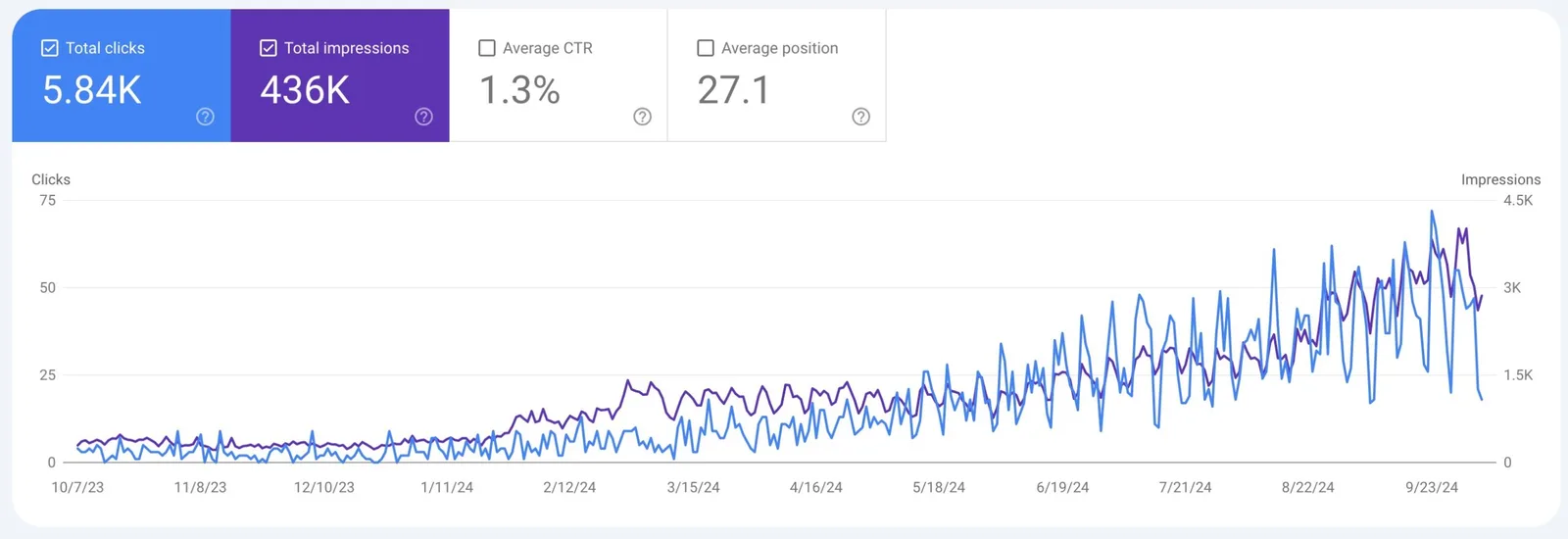 Search performance before and after content repair: flat for a year on 100 AI-generated posts, then steady growth once the content was rebuilt. 5.84K clicks, 436K impressions. (Google Search Console, client property)
That chart is a firm that ran 100 AI-written articles for a year and went nowhere, then grew once the content was rebuilt to say something only a practitioner could say. The full story of why volume alone stalls, and what replaced it, lives in our content marketing breakdown. The short lesson is that a search engine and a prospective client want the same thing from your writing: a point of view that could only come from someone who has done the work. A hundred posts of nobody in particular lost quietly to one post with a real name on it, and the machine could tell the difference before any human did.
Content also behaves differently from paid search over time, which matters the day a budget gets tight. One Albuquerque firm generates about $62,000 a month in organic traffic value from content that keeps working long after it was published, while a firm in Mobile spends $13,280 a month on ads to earn 8 organic clicks, roughly $1,660 per organic-equivalent click. Ads stop the moment the budget does. The article you published last spring does not. Both belong in a healthy plan, and I make the case for paid search as the fast-acting half elsewhere, but only one of the two keeps paying you back after you stop feeding it.
Rankings, in the end, are earned by content a real person is willing to put their name on.
AI search: how family law firms get cited in the answer
A citation inside the AI answer has quietly become one of the most valuable places your firm can appear. When a searcher reads an AI Overview and never clicks, it looks like a total loss, and for uncited firms it is. For the firm named in the summary, it is the opposite. Brands cited inside AI Overviews earn 35% more organic clicks and 91% more paid clicks on the same query than brands that are left out. And the visitors who do arrive from AI convert at 4.4 times the rate of ordinary organic traffic, with AI referral traffic up 527% year over year. The click you lose to the answer box is being replaced by fewer, better clicks, if you are the one being quoted.
This matters more for legal work than for search generally. Professional-service categories trigger AI answer boxes at unusually high rates. LocalFalcon’s whitepaper found personal injury attorney queries return an AI answer 62.1% of the time. Family law sits in the same neighborhood: emotionally loaded, research-heavy, exactly the kind of question people now ask a machine before they ask a person.
Ranking well in Google does not automatically get you cited, though, and this is where a lot of money gets wasted. Fewer than 10% of the sources ChatGPT, Gemini, and Copilot cite also rank in Google’s top 10 for the same query. Generative engine optimization, the work of earning citations inside AI answers, is its own discipline, measured on its own terms, layered on top of traditional SEO rather than falling out of it for free. Pure informational content compounds this. Semrush found that “what is” and “how does” queries now resolve on the results page 74% of the time, which turns a plain explainer into a citation play more than a traffic play.
The value also splits by intent. Branded searches with an AI Overview actually gain clicks, an 18.68% lift when someone is already looking for you by name, while non-branded searches lose about 20%. That tells you where the effort pays: becoming the name people already reach for, and becoming the firm the answer cites on the questions that have no brand attached to them yet.
Genuinely expert content has a specific meaning in this context, and Google spells it out. Content that carries a unique point of view and first-hand experience, the thing a generative model cannot produce on its own, is what earns a place in the answer. A tidy restatement of what is already online does not. For a family law firm that is good news, because you hold the one input no content mill can fake. You have actually sat across the table from these clients, in this county, under these judges.
Here is the plain version, because someone is probably selling you the opposite. The lever that gets you cited is crawlable, clearly attributed, genuinely expert content. Schema markup, the behind-the-scenes tags that label your firm’s details for search engines, is not that lever, whatever the pitch deck says. Google’s own developer guidance, updated in July 2026, states there is no special schema.org markup you need for its AI features, and names as myths the llms.txt file, the chopping of content into AI-sized chunks, and the rewriting of pages for machines. None of it is used by Google’s AI systems, which run on the same core ranking and quality machinery as regular search. If someone is selling you an AI schema package, keep your money. The attorneys I talk to already suspect this, because the category has a reputation. As one wrote, “the SEO companies share nothing like it’s Fort Knox.” The honest move is to say the plain thing out loud.
You can check where you stand this month rather than guess. Two tools do the job. Google Search Console now carries a generative-AI performance report showing when your pages surface in AI features. And a citation-share check, which is what our own citation-audit runs, queries Perplexity, ChatGPT, and Gemini for the questions your clients ask and records who gets named, sorting each query into cited-and-clicked, cited-only, clicked-only, or missed entirely. Run it once and you stop arguing about whether AI matters and start seeing exactly which answers you are absent from.
The front page of your firm is now a sentence in someone else’s answer. The work is earning your way into that sentence.
The technical floor: what your site must get right
Search and AI can surface only what they can crawl and parse. Everything above this section assumes a site that a machine can actually read, and that assumption fails more often than you would think. Entity Presence, the machine-readable layer of who your firm is, was the weakest of our three scoring dimensions in every metro without exception. Even the strong markets show it. Madison, Wisconsin, one of the better performers, still averages 64 on Entity against 71 on visible expertise. In Eugene, Oregon, not one firm had detectable schema markup anywhere. The knowledge is real across those markets. The site’s ability to communicate it is not.
The clearest proof that this is fixable is a five-attorney firm in the Pacific Northwest we worked with. It scored 65, stuck in Needs Work, despite content quality already at 87, with 5,000-word service pages citing specific statutes and local courts. After a single working session, with no new content written, the overall score moved to 90. Entity Presence rose from 53 to 92. The visibility of the firm’s expertise climbed from 55 to 77. Content ticked up to 92 on its own, because the words were finally legible.
Here is what that session actually did, none of it glamorous:
- Hardcoded the testimonials as static HTML on the homepage and seven service pages, because they had been rendered by JavaScript and were invisible to crawlers.
- Added AggregateRating review schema so the star ratings could be read as data.
- Distributed the attorneys’ credentials, bar numbers, law schools, and specializations onto every major service page instead of one isolated bio.
- Added the firm’s Avvo, Justia, and Martindale directory URLs as sameAs references in the structured data, linking the site to its own reputation elsewhere.
- Changed blog author attribution from the firm name to the founding attorney’s credentialed byline.
- Added the social profiles to the footer and surfaced existing Avvo awards on the bios and in the Attorney schema.
Every fix took existing, true facts and made them machine-readable. That is what schema actually earns you: eligibility for rich results, and entity disambiguation, the work of tying your firm name to your attorneys, practice areas, and location in Google’s knowledge graph that both classic and AI systems draw entity facts from. Worth doing, as part of a healthy family law firm SEO program. Google’s guidance is clear that it is not an AI citation hack, and both things are true at once.
The rest of the floor is table stakes. Your pages have to be indexed and meet Google’s standard technical requirements to be eligible for AI features at all. Core Web Vitals and mobile rendering have to be sound, and this is not a formality: a large share of these searches happen on a phone, often at a kitchen table late at night, so a page that loads slowly or reflows as it draws is losing the client before a word is read. If the site is JavaScript-heavy, it needs the standard care so a crawler sees what a visitor sees, which was the exact failure that had those testimonials hiding in plain sight above. And the basics have to be finished, which sounds obvious until you find, as I did in the dataset, a firm with “Write your caption here” still live in its hero and a 131-year-old firm proudly displaying the default WordPress “Hello World!” post.
One warning that costs firms dearly. Rebuilding on a new platform can wipe every signal this section is about. A Chambers-ranked Albuquerque firm generates $89 a month in organic value, apparently after a migration erased its entity signals. A self-described premier boutique in Grand Rapids sits on a template with no schema at 92 clicks a month and a score of 35. You can read the scoring framework in the benchmark to see how fast those points disappear. Your credentials were real all along. The site was hiding them.
How to tell if it’s working: a measurement framework
Only one number settles the argument: booked-and-paid consultations. As one attorney put it, drawing the line most firms never draw, “we consider a qualified lead to be a person who schedules and pays for a consultation. They think anyone who calls in is a qualified lead, and they simply are not.” Impressions, traffic, and rankings are inputs. Signed cases are the outcome, and the two get confused constantly.
The distrust here is earned. An attorney on r/LawFirmMarketing wrote that “we started our law office with Scorpion and it almost ended us,” six months of paying more than they earned. After a run like that, no dashboard gets the benefit of the doubt, and it should not. That exhaustion is the baseline in this market. “This is our third law firm marketing company and they are telling me the same crap,” another owner wrote, worn down by people who were nominally on their side. Skepticism this deep is earned pattern recognition, learned one bad vendor at a time.
I will hand you our own version of the failure. Melvin & Torrone, a family law firm we run marketing for, had a rebuilt site that fired its lead-tracking event correctly on the thank-you page. But the analytics account was still set to count only the events from the old website as conversions. So in June 2026, the dashboard reported zero conversions while 175 real people reached the thank-you page and converted. A working program that its own analytics called dead. That was our oversight, and it is the whole lesson: you cannot trust a dashboard you have not validated end to end.
This is the heart of the attribution problem that makes seo for family lawyers feel like a scam even when it is working. One marketer described the state of the art as “more art than science,” and another admitted, “never had anybody audit the whole funnel. That’s what I’m looking for but I don’t know where to even start.” Most firms are further from that answer than they think. An in-house marketer described a five-lawyer firm with almost 4,000 contacts where no one could name the largest referral source, “running off vibes alone.” You cannot improve what you have never once counted.
The frame that fixes it is boring and reliable. Instrument the conversion event, confirm with your own eyes that it fires, then reconcile the count against what actually happens at intake and how those consultations get booked. Stop grading on traffic. Grade on the calendar.
Add one AI-era input to that dashboard, the citation-share check from the section above, so you can see your visibility inside the answers, not only the blue links. That is the full picture: booked cases, validated tracking, and citation share, reviewed together.
None of this means measurement is hopeless. Measured correctly, Melvin & Torrone generates more than 100 booked appointments a month from digital channels, and our estate-planning client Dumm Law pulls more than 7,000 organic clicks a month. The firms that struggle are usually good at the marketing itself. They are just measuring the wrong thing.
Ranking is the question everyone asks. How many people booked because of it is the one that matters, and most firms have never once sat down and answered it.
Questions about SEO
How long does family law SEO take to work?
Local map-pack gains often show within two to three months. Competitive organic rankings usually take six to twelve months of steady work, because they compound rather than switch on. Some fixes move faster: the entity and attribution repairs in this article can lift a site's visibility in weeks, since they surface expertise that already exists rather than building anything new. Anyone promising page one in 30 days is describing something that will not hold.
Does AI search change whether SEO still matters?
No, it raises the stakes. Google's own guidance says AI Overviews and AI Mode run on the same core ranking and quality systems as regular search, so foundational SEO (valuable content, clean technical structure, complete local details) is the basis for AI visibility rather than a separate track. The firms that get cited in AI answers are the ones whose expertise is already crawlable and clearly attributed.
Should I hire an agency or handle family law SEO myself?
You can do a surprising amount yourself. Completing your Google Business Profile, checking that your credentials are visible to a crawler, attributing content to real attorneys, and opening Google Search Console are all within reach. Hire out the technical and ongoing work if you lack the time, but hire only a firm that will show you which booked consultations came from search. Ask for attribution before you sign anything.
Do I need special schema markup to get cited in AI Overviews or ChatGPT?
No. Google's developer guidance, updated in July 2026, states plainly that there is no special schema.org markup required for its generative AI features. Schema remains genuinely valuable for traditional rich results and for entity disambiguation, connecting your firm to its attorneys and location in the knowledge graph. Treat anyone selling an "AI schema package" as selling you the wrong thing. The real citation lever is expert, crawlable, clearly attributed content.
How is GEO different from regular SEO, and do I need both?
Yes, you need both. Generative engine optimization, or GEO, targets citation inside AI answers, while SEO targets ranking in traditional results. They overlap but do not guarantee each other: fewer than 10% of the sources ChatGPT, Gemini, and Copilot cite also rank in Google's top 10 for the same query, per eMarketer. GEO gets measured on its own, layered on top of solid SEO rather than replacing it.
Why would a board-certified attorney score worse than a less-credentialed competitor?
Because search and AI systems recognize only what is structurally visible. A certification buried on a secondary bio page, written in body text, or rendered by JavaScript effectively does not exist to the machines deciding who gets found, no matter how real or hard-earned it is. In our audit, board-certified specialists scored at or below their market average in 11 of 20 metros. The credential is real; the signal is missing.
Go deeper
What We Learned Auditing 351 Family Law Firms
What I found auditing 351 family law firms across 20 U.S. markets: a 54/100 average, $2.4M a month in fragile ad spend, and why the bar to lead is low.
Local SEO for Family Lawyers: The Map Pack Playbook
Most family law calls start in Google's local map pack. The field-by-field playbook to get in, build a review engine, and prove which calls came from search.
Want this looked at by someone who's done it?
A 60-minute working session on your firm's marketing: what to fix first, what to stop paying for. $250, and it credits toward any future project.
Book your session