Content Marketing for Family Law Firms
Content marketing for family law firms with real numbers: what to write, whose name earns the credit, and the 100-article AI mistake that cost a year.
By Josh Kilen · Updated July 17, 2026
You paid someone to write your blog. Every month the posts arrived on schedule, each one competent, each one forgettable, and not one of them ever became a phone call. Or maybe you skipped that experiment and you are reading this with ChatGPT open in the next tab, wondering why you would pay a human being a dollar for something a machine does instantly and for free.
Both are reasonable places to be standing.
What I keep running into, though, cuts against what most firms believe. The family law practices whose content actually brings in cases are almost never the ones publishing the most. The firms drowning their blog in posts tend to be invisible. The firms with a handful of genuinely useful pages get found, get read, and get cited.
So let me state the argument this whole piece rests on. Content marketing for family law firms works when it carries a practicing attorney’s judgment and first-hand experience. Volume, on its own, earns nothing. That is the spine, and everything below is evidence for it.
I am not guessing at this. I audited 351 family law firms across twenty metros, I have run content programs for law firms for years, and a few sections down there is a real before-and-after chart from one of our own clients that shows exactly what happens when a firm gets this wrong and then fixes it.
One more thing before we start, because it matters. My company uses AI heavily, every day, and what follows is the opposite of an anti-AI argument. Google itself draws a clear line between AI used well and AI used badly, and the line sits somewhere most people do not expect. That distinction turns out to be the whole game.
Let me start with what content is actually supposed to do.
What content is actually for in family law marketing
In family law, content is how a firm answers, in public and in advance, the questions a frightened person is already typing into Google at eleven at night.
Someone facing a custody fight or a divorce does not call a lawyer first. They research. They want to know what a parenting plan looks like in their county, how long this is going to take, what it is likely to cost, and whether the thing their spouse just threatened is actually legal. By the time they pick up the phone, they have read a dozen pages and formed a quiet opinion about who sounds like they know what they are doing.
And they are not only gathering facts. They are auditing you. A person in the middle of the worst month of their life is deciding, page by page, whether you sound like someone who will steady the situation or add to the chaos. A services page that lists “Divorce, Custody, Support” answers none of that; a page that walks them through what actually happens at a temporary orders hearing does.
Content is your chance to be useful to that person before you are ever hired. Answer the real question, in plain language, from the perspective of someone who has actually stood in that courtroom, and the relationship has already started. That is the entire mechanism behind family law content marketing, and it is more human than the word “marketing” makes it sound.
Then those answers compound. A single page helps one searcher. A connected set of genuinely expert pages on one practice area, custody, say, or property division, signals something larger to both readers and the ranking systems that decide who shows up: this firm knows this subject in depth. That depth is topical authority, and it is why one well-built cluster of pages outperforms a hundred scattered posts on unrelated topics.
You can watch this happen in miniature. Someone lands on your explainer about how custody is decided, reads it, and clicks through to your piece on relocation, then your rundown of what a guardian ad litem actually does. Three pages in, they are no longer comparing prices. They are reading their future lawyer.
Most firms are nowhere near this. In our audit of 351 family law firms, the average search-visibility score landed at 54 out of 100, with more than half of firms sitting in the critical-gap range. The problem is almost never a lack of knowledge. It is knowledge that never made it onto the page in a form anyone could find.
That reframes the whole task. Content is your expertise made findable, and for a fuller list of the questions worth answering, our guide to family law marketing ideas is a good place to start.
Once you see content this way, the reason so much legal content marketing fails becomes obvious. A blog stuffed with generic posts is just a schedule being satisfied, and it convinces no one.
Which brings me to the clearest example of that failure I have on record.
The 100-article mistake: a case study in volume without judgment
One family law firm we worked with came to us after a content vendor had published roughly a hundred ChatGPT-written articles to its blog. The articles were fine. Grammatical, on-topic, inoffensive.
For about twelve months, they did absolutely nothing. Search traffic stayed flat the entire time, cheerfully indifferent to the pile of new pages accumulating beneath it. Volume was the whole strategy, and volume delivered nothing.
What the firm had been buying, without quite realizing it, was activity. A monthly report showing so many posts published, so many words written, a content calendar filling in with satisfying little checkmarks. All of it real. None of it connected to a single new client.
The reason is not mysterious once you read the pages. They were articles anyone could have written, or more precisely, articles any model could have generated in seconds, because that is exactly what happened. Nothing in them came from having actually practiced family law: no real client question, no local specificity, no judgment about when the tidy general rule breaks. A searcher got nothing they could not have gotten from the machine directly, which meant there was no reason for the page to exist and no reason for Google to rank it.
This is where people expect me to say AI ruined the blog. That is not what happened, and Google is unusually clear on the point.
Google’s spam policies, last updated in May 2026, define scaled content abuse as generating many pages “for the primary purpose of manipulating search rankings and not helping users.” The policy explicitly includes “using generative AI tools … to generate many pages without adding value for users.” Mass-producing pages to fill a blog is, in Google’s own words, a named spam pattern.
Read the wording carefully, because the nuance is the entire lesson. The policy targets purpose and outcome: pages built to manipulate rankings, pages that add no value. It does not target the tool.
AI used with judgment, to help a real expert say something real, is fine and always has been. AI used as a substitute for judgment, to manufacture pages at volume, is the thing being penalized. The villain here is volume without judgment. The software never was.
So we fixed it, and the fix was unglamorous. We pruned the filler that served no reader, then consolidated the few salvageable posts into fewer, deeper pages that answered a question in full.
The rest we rewrote as content only a practitioner could produce: specific statutes, the local courts the attorneys actually appeared in, the questions clients ask across the consultation table. Every piece got a named, credentialed attorney’s byline instead of the vendor’s.
Consolidation did more work than it sounds like. Five thin posts circling the same custody question had been splitting whatever authority the topic could earn five ways, and competing with each other for the same ranking. Merged into one page that answered the question completely, they finally added up to something.
Then we waited, because this compounds over months, not days.
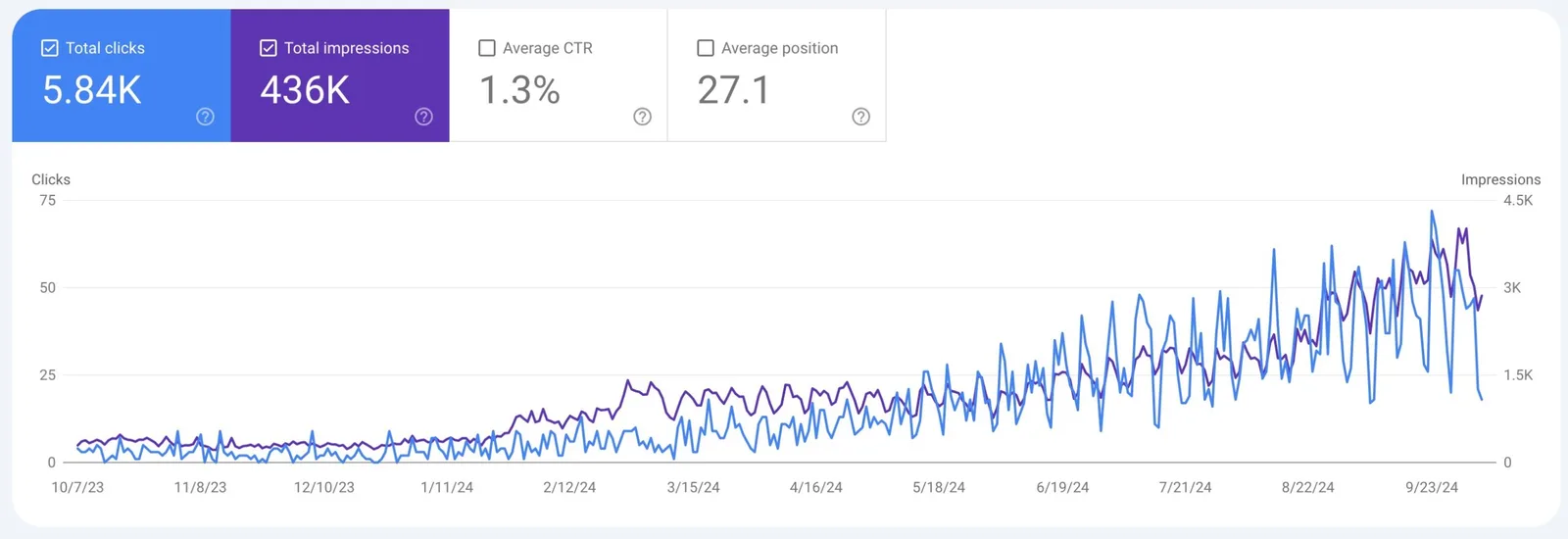 Search performance before and after content repair: flat for a year on 100 AI-generated posts, then steady growth once the content was rebuilt. 5.84K clicks, 436K impressions.
The same property that sat flat for a year climbed to 5,840 clicks and 436,000 impressions on the way up. Same firm, same practice area, same market. The only thing that changed was that judgment and experience replaced raw output.
The complete teardown of that project, what we cut, what we kept, and what the repair actually cost, lives in our full breakdown of the ChatGPT content mistake. And if you are wondering whether this firm was some unlucky outlier, it was not. The same pattern showed up across our benchmark study of 351 firms, which is where we first learned to recognize it on sight.
Here is the honest version of the AI question, then. In the hands of someone with real case experience and the judgment to edit, AI is a genuinely capable drafting tool. As a replacement for that experience, it produces a hundred articles and twelve flat months.
If volume no longer earns a firm its place, something else has to. Google spends a surprising amount of its own documentation describing exactly what.
What earns rankings and AI citations now
Google’s own generative-AI guidance answers this more plainly than any consultant would. What earns a place in an AI-generated answer, it says, is content with a unique point of view and first-hand experience, and it explicitly warns against content “that could easily be produced by a generative AI model.” The one input a content mill cannot fake is the one input that now matters most.
There is a relief hidden in that. AI Overviews and AI Mode run on Google’s core ranking and quality systems, the same ones that have always decided who ranks. You are not writing for two different machines. Content good enough to earn a traditional ranking is the same content eligible to be cited in an AI answer, so the work never splits in two.
That guidance lands differently once you notice where the clicks are going. Informational queries, the “what is” and “how does” searches, resolve right on the results page 74% of the time as of 2026, compared with 46% for commercial-investigation queries and 31% for transactional ones. When someone asks what a QDRO is, they increasingly get the answer without clicking anything at all.
A lot of firms read that number as a reason to stop writing explainers. That reading is backwards. The explainer is still worth writing; its job simply changed.
A clear, expert answer to “what is a QDRO” is now less a bid for a direct click and more a bid to be the source the AI answer quotes, and the firm that answer names. So you keep writing the pieces your clients actually ask about. You just write them to be cited: specific, experienced, unmistakably the work of a practitioner rather than a paraphrase of ten other pages.
Written to be cited has a shape. Answer the actual question in the first two sentences, before any throat-clearing. Be specific enough that the answer could only have come from your jurisdiction and your caseload. Include the number, the statute, the timeline that a generic article smudges into “it depends.”
An AI model surfaces the cleanest, most confident, most specific answer it can find on a page it trusts. Your job is to be that answer.
And being the cited source is worth real money. Brands cited inside AI Overviews earn 35% more organic clicks and 91% more paid clicks than uncited brands on the same query, and visitors who arrive from AI search convert at 4.4 times the rate of ordinary organic traffic. The click you seem to lose to the AI answer is often replaced by a warmer one, as long as you are the firm the answer decided to trust.
For a family law firm this changes the math on the humble explainer. “How is child support calculated in my state” will never be a glamorous page. But it is exactly the kind of high-anxiety, high-intent question where being the cited, named source puts you in front of someone at the precise moment they are deciding whom to call.
Notice what every one of these signals rewards: a real point of view, genuine first-hand experience, the texture of someone who has done the work. Which forces a question most firms have never actually decided on purpose. Whose experience is it, and whose name is on the page?
E-E-A-T for attorneys: making your expertise visible
The single biggest editorial decision in family law content is whose name goes on it, and most firms get it wrong.
E-E-A-T is Google’s shorthand for experience, expertise, authoritativeness, and trust, the qualities its systems try to detect in the people behind a page. For a law firm, experience is the valuable signal, and it is also the easiest one to throw away. You throw it away by publishing genuine legal expertise under the wrong name.
That first E, experience, is the newest letter Google added to the framework, and for law it is the one that separates a real firm from a content farm. Expertise can be researched. Authority can be borrowed.
Experience, having actually sat across from a terrified parent, filed the motion, and stood for the hearing, cannot be manufactured by anyone who has not done it. That is exactly why it is worth so much, and exactly why it is a waste to publish under a stranger’s name.
This is not hypothetical. Across our 351-firm audit, at least eight different web agencies were crediting law firm blog content to themselves, a web-development email or the agency’s own name, rather than to the attorney who supplied the expertise. One firm in Durham with 375 Google reviews, Inc. 5000 recognition, and eleven attorneys had its blog posts attributed to a web-developer’s email address. Every one of those posts was quietly building authority for a web shop instead of the firm that paid for it.
It usually is not malice. The firm’s site was built by an agency, the agency’s developer is the default author in the content management system, and nobody ever changed the setting. So years of hard-won expertise get filed under webdev@agency.com, and the firm never notices, because the byline is the last thing anyone reads.
Now the other direction. A single blog post in Asheville, published under a named attorney’s byline, ranks fourth in the entire country for “alienation of affection” and generates an estimated $14,130 a month in organic value. One post.
It out-earns firms in the same market that pushed out hundreds of unattributed articles. That byline was doing the heavy lifting.
Making your expertise visible in the writing is not complicated, and it does not require a marketing degree. Put a real, credentialed attorney’s name on the piece. Write from things you have actually seen: the statute that trips people up, how the commissioners in your county tend to handle a relocation request, the question every third client asks across the consultation table that the internet somehow never answers well. Specificity is the moat.
A model can generate a competent definition of legal custody. It cannot tell you how a particular local court behaves on a Friday afternoon, because it has never been there and you have.
There is a machine-readable side to authorship too, the structured author markup that helps search and AI systems connect a page to a real person, and we cover that in our SEO guide. Here the point is simpler, and free. Changing the byline from your vendor to the attorney who actually did the thinking costs nothing, takes five minutes, and hands the credit to the firm it was always meant to build.
Do that, and then decide how often you can realistically keep it up.
A sustainable cadence for a busy firm
Family law firms are not overproducing content. Across our audit of 351 firms, we found unfinished, abandoned content sitting live in every single metro we studied.
The evidence is a little embarrassing. “Write your caption here” still sitting in the hero text of a real firm’s homepage. A template’s placeholder name, “Premium Law,” surviving inside a published blog post at a firm that had won a $10.5 million verdict.
A firm that has been practicing for 131 years still displaying the default WordPress “Hello World!” post. Lorem-ipsum “Business Tagline” text live on a homepage where a value proposition should be. Nobody in that group had a volume problem. They started, and then they walked away.
Every one of those pages began as an intention. Someone set up the site, meant to fill it, got pulled into a trial, and never came back. That is the real condition of most family law firm content: plenty of it started, almost none of it finished.
The answer is simple to say and hard to do. Finish what you began, then keep it tended.
The goal was never frequency. It is depth, and after depth, maintenance. One genuinely expert, properly attributed piece that you keep accurate as the law and your practice change will outwork a weekly post that nobody, including you, would want to read. Content is an asset you tend, closer to a garden than a treadmill, and gardens do not reward panic.
So here is a cadence a solo or small firm can actually sustain. Once a month, take a real question from a consultation you just finished, the kind you have answered out loud a hundred times, and turn it into one deep piece. Talk it through, or dictate it on the drive home, and let AI do the typing while you supply the judgment, the specifics, and the name at the top.
That single move answers the objection I hear most, that every hour spent writing is an hour not billed. You are spending fifteen minutes of expertise you already have. Nobody is asking you to become a writer.
You will never run out of topics, because your intake generates them for you. The questions your paralegal fields on the phone twelve times a week are your content calendar, already written for you by your clients. Keep a running list on a sticky note by the desk. When the same question comes up for the fourth time, that is the next piece, and you already know the answer cold.
Before you write anything new, go back and update an older post that has drifted out of date. An outdated page is worse than no page, because a client who catches you citing a rule that has since changed will quietly cross you off. Freshness does real work here. It is the difference between a page that builds trust and one that erodes it.
That is the whole family law firm blog strategy in one line: a little, done well, kept current. If you do one thing after reading this, do not add a post. Open the oldest page on your site, read it the way a client would, and fix what is no longer true.
How to tell if it’s working: beyond pageviews
Grade your content on booked-and-paid consultations you can trace back to it, not on pageviews and not on rankings. Everything else is a proxy, and proxies lie.
I will use one of our own misses to show you how badly they can lie. One of our clients, the family law firm Melvin & Torrone, went through a site rebuild. The new site fired its lead-tracking event correctly every time someone reached the thank-you page.
But the analytics account was still configured to count only the old website’s events as conversions. So for the month of June 2026, the dashboard reported zero conversions. Zero.
Meanwhile 175 real people had reached that thank-you page and become leads. The content was working the entire time the dashboard insisted it was dead, and it was our oversight that let the two disagree for as long as they did.
Dashboards earn their keep only after you validate them. An unvalidated one is worse than none, because it lets you make confident decisions on numbers that are wrong. So validate it, end to end.
Set up the conversion event on your thank-you page, the signal that should fire every time someone becomes a lead. Then submit the form yourself and confirm with your own eyes that the number moves. Then reconcile that number against your intake: do the leads the dashboard claims actually match the humans your front desk talked to? If you cannot trace a signed matter back through that funnel, you are, in the words of one firm owner I came across in the research, “running off vibes alone.”
A working chain is not fancy. A form submission creates a lead in your CRM, tagged with how it arrived. That lead becomes a consultation, the consultation becomes a signed matter, and you can follow the thread all the way back to the page that started it.
Most firms already have every link in that chain. What they lack is anyone connecting them, which is how a practice ends up with four thousand contacts and no idea which content, or which referral source, is actually feeding it.
Once you can actually see it, the payoff of good content becomes obvious, because it keeps compounding long after you stop paying for each unit of attention. Paid search stops the moment the budget does. A well-built page keeps getting found for years, and keeps getting cited by the AI answers built on top of it.
Our own numbers show the gap plainly: Dumm Law, an estate-planning firm we work with, sustains more than 7,000 organic clicks a month, and Melvin & Torrone books more than 100 appointments a month from digital. That is what family law firm content looks like when the measurement is honest enough to reveal it.
That compounding is the whole case for owned content over rented attention. An ad is a faucet: useful, immediate, and off the instant you stop paying the bill. A genuinely good page is closer to a well. It takes longer to dig, and then it keeps giving water back for years, to searchers and to the AI answers that quote it.
Content works. That part is settled, by Google’s own guidance and by the chart earlier in this piece. The open question, the one almost no firm answers before hiring a vendor and firing them a year later, is whether you have built any honest way to see it working.
Build that first. Then the argument about whether content is worth the trouble answers itself, and you get to spend your evenings billing instead of guessing.
Questions about Content
Does blogging still work for family law firms in the AI era?
Yes, when the content answers real client questions with a practitioner's depth and a named attorney behind it. Google's AI features run on its core ranking systems and reward first-hand experience, so genuinely expert content is the basis for both traditional visibility and AI citation. Generic posts published on a schedule do nothing. Our 100-article case study is the proof.
Can a family law firm use AI to write its content?
AI is a capable drafting tool in the hands of someone with judgment and real case experience. Used as a replacement for that judgment, mass-produced with no editing or expertise, it becomes what Google's May 2026 spam policy calls scaled content abuse, and it flatlines. The line Google draws is about purpose: adding value for readers versus manufacturing volume to fill a blog.
What should a family law firm actually write about?
The questions clients ask in consultations: custody, cost, timelines, what to expect, and what a specific filing means in your county. Informational queries increasingly resolve inside AI answers, so these pieces work as authority and citation plays even when they earn fewer direct clicks. What matters most is whether a real practitioner's knowledge visibly shows in the writing.
How do I know if our content is generating cases, not just pageviews?
Grade it on booked-and-paid consultations traced back to the content, not on pageviews or rankings. Set up the conversion event, submit the form yourself to confirm it fires, and reconcile the numbers against your intake records. A dashboard can read zero while people are converting. One of ours did, while 175 people converted. Validate it before you trust it.
How often should a family law firm publish?
Less often than you think, and more finished. Across 351 firms we found unfinished placeholder content live in every metro we studied, which means most firms are half-finishing rather than overproducing. One genuinely expert, properly attributed piece a month that you keep updated will beat a weekly post nobody wants to read. Depth and maintenance beat frequency.
Go deeper
The 100-Article ChatGPT Mistake
A firm paid for 100 AI-written articles and got a year of flat traffic. The repair, the recovery curve, and what AI is actually good for in law firm content.
Family Law Marketing Ideas That Actually Work
Family law marketing moves ranked by what actually fills consultation calendars, in the order a small firm should deploy them, with the reasoning for each.
Want this looked at by someone who's done it?
A 60-minute working session on your firm's marketing: what to fix first, what to stop paying for. $250, and it credits toward any future project.
Book your session